Keeping responders safe: civil documents, safe spaces grounded in local custom, and making use of international protection systems.
Civil documentation

Local residents in Darfur have lost their civil documents as a result of forced displacement, and the lack of documentation is a major limitation of their mobility. The lack of personal identification limits people's ability to move around, particularly when navigating between military checkpoints. (The lack of a passport is considered the most significant reason individuals may be prevented from traveling abroad).
The loss of civil documentation has deprived vulnerable groups and communities in areas most affected by the conflict of access to humanitarian assistance and basic services such as education and health. A birth statement, officially known as a birth certificate, is one of the most important documents required by service providers to provide support and receive educational and health services for children.
The interconnectedness of documents and individuals' lives poses a significant challenge in the future, as most documents require additional proof for issuance. This means that the loss or absence of a document may prevent individuals from obtaining the required document. For example, an individual's inability to issue an official marriage contract or marriage certificate may result in the inability to issue birth certificates for their children.
In Darfur, the loss of civil documentation is one of the most prominent challenges facing humanitarian responders. 88% percent of respondents and humanitarian actors surveyed reported that it restricts their freedom of movement, making it the most significant challenge. This was followed by the inability to complete education at 60%. 53.85% indicated that this loss leads to the loss of rights for individuals who have lost loved ones, and 52.31% indicated that it deprives them of basic services.
On the other hand, 43.08% confirmed that women face a complex situation and that access to humanitarian aid becomes difficult, while 41.54% indicated that this leads to forced unemployment. 38.46% reported being denied compensation, and 24.62% reported being subjected to enforced disappearance. Finally, 16.92% indicated that the loss of documents could lead to murder, as security agencies deprive their members of their civil documents throughout their employment. Therefore, anyone without identification documents is classified as belonging to one of the warring military groups.
Some groups face difficulty in obtaining these documents due to their affiliation with specific ethnic groups or geographic regions. Civil documentation institutions and census archives face significant challenges, with 41.54% of respondents indicating that these institutions and census archives are out of service but still retain their records and are unable to provide services. Meanwhile, 29.23% reported that these institutions were completely damaged and lost their archives. 21.54% indicated that these institutions were still operating to a limited extent. Finally, 7.69% indicated that archives were partially damaged and the institutions were completely out of service.
Awareness efforts on civil registration led by humanitarian responders in Darfur
Humanitarian responders in Darfur led awareness-raising efforts on the importance of civil registration, a system established by governments to record vital events (birth, death, marriage, and divorce) of their citizens and residents, giving them the right to identify themselves. The United Nations defines civil registration as the continuous, permanent, compulsory, and universal recording of vital events related to a population and the characteristics of those events, in accordance with each country's legal regulations. Civil registration aims to create legal documents that can be used to protect people's rights and identify them.
Local communities now have a variety of alternative institutions and actors for issuing civil documentation, responsive to the local context and the challenges they face. Census offices and hospital internal registries issued birth and death certificates, while notaries used commercial contract forms and official seals to issue marriage and divorce certificates. For other documents, such as national identification numbers and passports, no alternative entities were able to officially issue them in most affected areas. However, civil administrations and sheikhs played a role in managing some of these processes, particularly the issuance of personal identification documents and proof of residence documents, effectively protecting thousands of civilians in conflict-affected areas. In some areas, youth and civil society initiatives were used to provide these services by issuing identification cards and documents to respondents. However, the potential for forgery was high, so these were abandoned in some areas, while they proved effective in other areas, such as Zalingei.
Development of informal and alternative solutions for lost civil documents
Following the loss or inability to obtain civil documents, local communities developed informal and alternative solutions. The most prominent solutions included obtaining proof of identity from local leaders and issuing temporary documents from shelters and IDP camps, both accounting for 44.62% of the respondents. Some also resorted to obtaining written proof from the service provider, or using electronic archiving and internal records of service institutions as documentation alternatives. The results also showed the use of temporary documents or paper copies of official documents when moving to preserve the originals from loss or damage, in addition to the use of civil payment invoices as proof of civil facts.
Civil documents are a key tool for protecting humanitarian responders, as anyone without civil documentation is not recognized before the law. Failure to register births in the civil registry means that the child does not exist before the law. This can lead to children being deprived of citizenship and unable to access state services. Civil documents also ensure that rights are not deprived, as several rights require civil documentation to be obtained. For example:
- A birth certificate guarantees a child's right to education, inheritance, and family reunification.
- Marriage certificate gives women their marital rights.
- The divorce certificate guarantees the rights of both spouses and the wife's right to receive her dowry, alimony, and child support, in addition to her ability to enter into a new marriage.
- Death certificate guarantees the rights of the heirs
Civil documents facilitate access to assistance, and eligibility for assistance often requires civil documents to prove the following:
- Person's identity
- The child's lineage to his parents
- A woman's relationship with her husband
It must be emphasized that the lack of documentation deprives some vulnerable groups of access to assistance and services designed specifically for them, such as:
- Widows who may be denied services due to lack of proof of their husband's death.
Civil documents also protect people from vulnerability in both home and host communities for several reasons, including:
- Issuing civil documents empowers individuals and prevents their vulnerability.
- Having civil documentation protects people from abuse and violations, including arbitrary arrests and detention.
- Having documents gives people freedom of movement whether inside or outside Sudan.
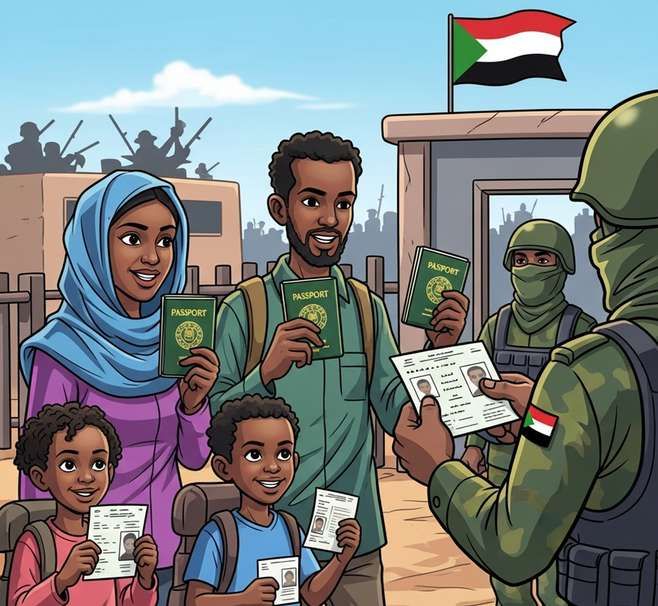
What responders themselves said about this problem, as printed in the English edition of the guide.
I deeply regret that most students do not have passports, which prevents them from traveling to a safe place to continue their studies. A passport is a very basic and necessary document, and without it, it is difficult to overcome travel restrictions to the places one desires.
Currently, in Nyala and in all areas controlled by the Rapid Support Forces, there is no available civil registry. Data on births, deaths, and other official documents are recorded in a large paper register archive, and data can be retrieved from this register using the registration number or page number. However, in the event of any new raids or clashes, there is a high probability that all records will be lost, posing a serious threat.
I believe the biggest problem we faced regarding civil documents in the current war, was that government institutions and other agencies where people worked kept the original documents of their employees. This practice was one of the main reasons for the exacerbation of the current problem, as these institutions were subjected to systematic looting and were unable to protect citizens' files or transfer them to safe places. Many documents were burned, destroyed, or even thrown into the streets. People searched for them for years, directed from one place to another to no avail. Only about 30% of them were able to retrieve their files, while the rest still do not know the fate of their documents and their whereabouts.